
Where Are You Really on the Growth Curve?

Are You Aligned?
Have you noticed that growth often feels harder than it should?
You’ve read the books, listened to advice, and refined your strategy.
But when you sit down with your key leaders, there’s actually no real agreement on what the priorities should be.
In my experience working with B2B tech and services firms, the issue is often simpler than it looks:
You’re not aligned on what to do, but you don’t actually agree where the business actually sits on its growth journey right now.
If you don’t have this alignment around your growth strategy you probably don’t have a clear set of product development, sales or marketing actions that are right for your business right now.
One of the most helpful frameworks I’ve found to bring clarity is Geoffrey Moore’s book Crossing the Chasm.
Crossing the Chasm - Explainer
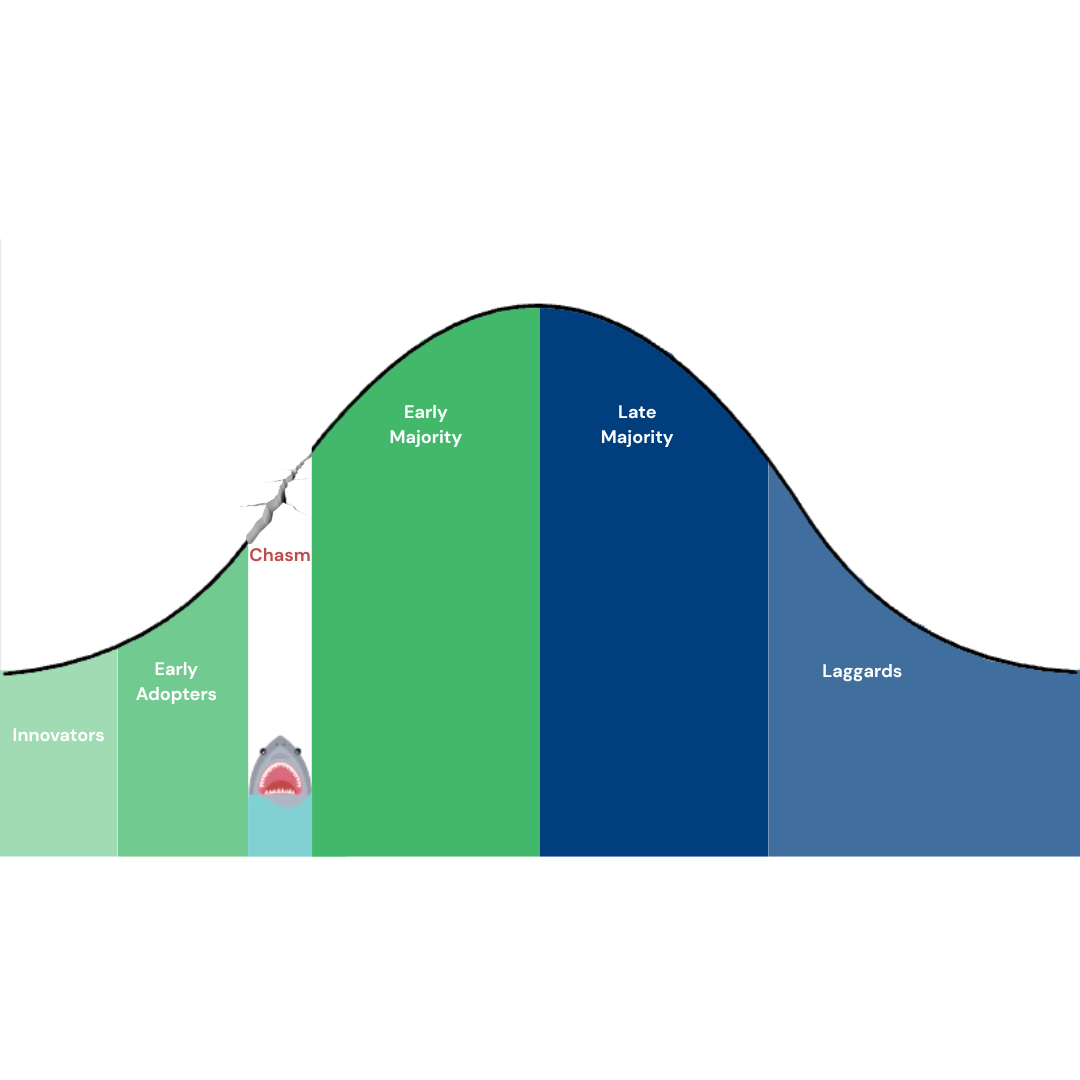
Crossing the Chasm is a model originally developed for B2B technology companies. It describes how new products and services are adopted over time and how to approach the market depending on which stage you are in.
Moore also explains why so many businesses stall before reaching mainstream success - in essence because their approach is not fit for purpose at the stage they are currently in.
As businesses grow they tend to move through stages:
The Early Market
Innovators - these are your beta clients, who are really excited about the solution and are happy to be guinea-pigs with all the ‘rough edges’
Early adopters - who want to be ‘the first’ and think this might give them an advantage in the market
The Mainstream Market
The early majority - they will buy because they think there is a good ROI argument, but they are risk-averse and want a fully-functioning offering
Late majority and laggards - this is when you are so mainstream that there’s very little question about who to buy - you are the industry default!
The Chasm
Between the two markets is a ‘chasm’ which businesses have to cross. Before crossing you need a ’whole product’ solution, including clear value, customer support, documentation, case studies etc.. Moore argues that many businesses try and reach the mainstream before they are ready and therefore founder in the chasm.
I think the key takeaway for businesses is this: each stage requires a very different sales and marketing approach.
What works brilliantly with early adopters often fails completely with more pragmatic buyers. And trying to scale before you’ve crossed the chasm is one of the fastest ways to:
Burn cash
Exhaust your team
Damage credibility in the market
Cause internal friction about where the issues sit
It Fits Most B2B Businesses
Although the model came from tech, it applies just as well with B2B services firms, engineering-led businesses, and complex, relationship-driven businesses.
I have also found it useful where you have an existing and established ‘mainstream’ business develop a new offering. The two products/services will need two very different approaches, as one may be right back at the start of the curve and need a different approach to its older sibling.
Why This Matters for Leaders
I definitely don’t think CEOs and leaders struggle because they lack ideas. Mostly, I see the struggle is with implementation - where effort and resources get spread too thinly. And whether you have $10,000 or $10million to spend on growth - trust me, you still will need to prioritise.
You need a shared agreement of what matters right now.
As we kick off a new year, I think it’s really important to ensure you and your team understand and agree where you are now and where you are going next.
Sure, you need to agree where you are going in the long-term, but you need to get there. Jumping ahead too soon might mean you never reach that point, or it might take you a lot longer than you want.
Used well, I have seen this framework help with:
Alignment – getting leadership, sales, marketing and product teams on the same page
Clarity & focus – stopping mismatched activities that keep people busy, but drain energy and budget
Confidence – knowing your priorities actually fit your current reality
That clarity feeds directly into outcomes leaders care about: revenue growth, pipeline health, effective use of spend, and confidence in front of boards or investors.
How To Tell Where You Sit?
OK, so this might all sound theoretical, so below are some indicators and questions for you to ask to help identify where your business sits, and therefore what actions to prioritise.
I’ll start with a story.
A professional services business who was already highly successful in their field globally. They were entering a new geography and leading with a product that was relatively early stage. We all agreed that Crossing the Chasm was a useful framework for us to work to, but yet we still seemed not to agree on what our priorities were.
One person was off courting big organisations - exciting blue-chip names we’d love to have on our website, but it was taking time. A lot of time and effort and as yet, little payback. They wanted trials, meetings and case studies.
Another person was flying all over the place doing demos and meeting with a range of ‘prospects’ - from small to mid-sized, and in different segments. He was exhausted and crying out for resources to support his conversations - from case studies to datapoints, to flexible pricing.
We wanted to consolidate our approach. Surely it should be easy as Crossing the Chasm has a playbook approach of what to do at each stage?
But when we looked at the Crossing the Chasm diagram, we all stabbed our fingers in a different position! And therein lay our problem.
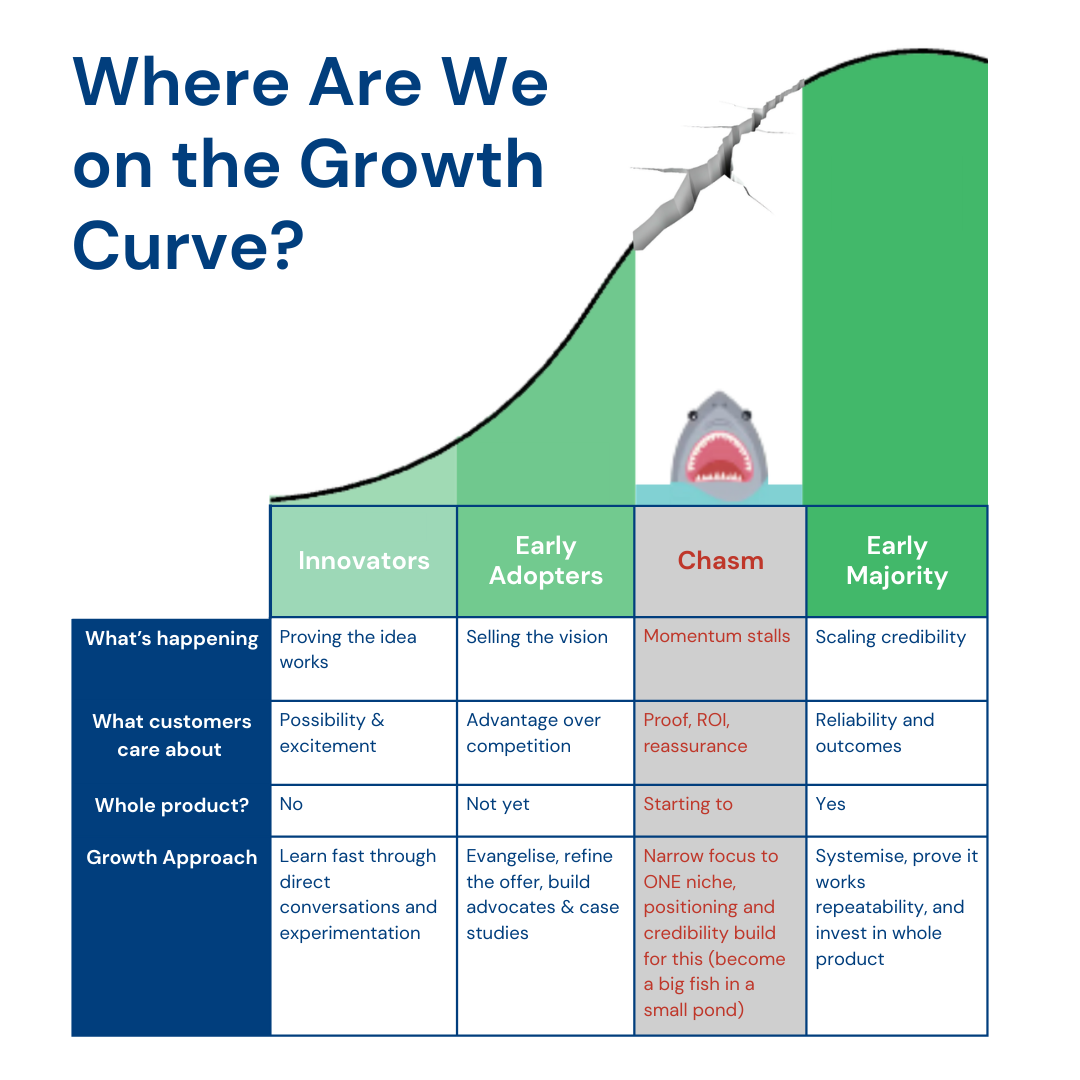
That was when I developed the diagnostic questions below. Step one was getting agreement on where we were.
Once we did this, it was much easier to agree on our priorities and to have a shared language of what we were trying to do and WHY.
Once used with them, it has provided a useful guide to a range of conversations with businesses.
Where Am I?
Below are practical indicators I use with leadership teams to identify where they may sit.
I have just focused on the initial stages here, as this is where I think many of the businesses I see need most help.
Questions
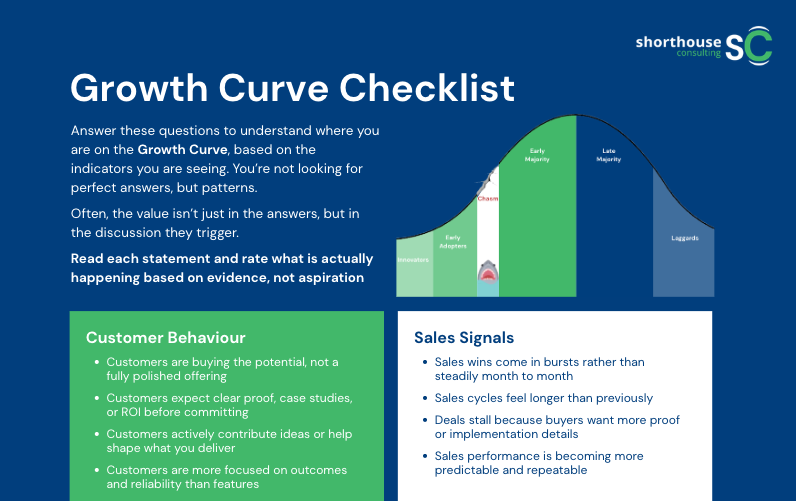
Rather than debating opinions, I’ve found it far more useful to ask structured questions of the team and see what evidence you have of where you are.
Often, the value isn’t just in the answers, but in the discussion they trigger.
Download the full set of diagnostic questions
Next Steps
If this resonates, I suggest these next steps:
Run the diagnostic - get your growth team in a room and answer the questions honestly
Get alignment - agree where you are on the curve, even if there’s some uncomfortable discussions on the way
Reset priorities - decide what matters for this stage, and what should wait
Focus on the next 90 days to get action.
Growth doesn’t stall because people are not working hard. Despite having a great offering, it often stalls because you are all pulling in different directions.
If you have clarity on where you are right now, you will know where you need to prioritise effort.
If you’d value an external perspective to help get clarity and turn it into action - get in touch.
Get in Touch

We partner with CEOs and leaders of B2B tech and services companies who are ready to grow.
We have a particular sweet-spot for helping teams where there is a low-volume, high value offering that involves a personalised sales approach. ♥️
We help you get a plan that is aligned with your business objectives, and build a ‘growth engine’ that turns your marketing and sales activity into something that scales with you as you grow.
If you are looking to grow your business and are interested in building a sustainable approach to growth, then I’d love to chat.
Give me a shout, Helen
021 900335
helen@shorthouse.co.nz