
The B2B Growth Model Has Changed - But Kiwi Businesses Are Not Keeping Up

Summary
The B2B growth model has shifted, but most NZ businesses haven't caught up.
Data shows that buyers are 70% through their evaluation before they contact you, 94% use AI tools like ChatGPT during research, and 80% of the time the winning vendor is already chosen before sales conversations even start. Buying groups now average 13 people, deals need 5-12 follow-ups to land, and outcome-focused selling beats feature-focused selling by 30%.
The fix isn't doing more, it's getting clear on positioning, messaging and visibility so you're shortlisted before the conversation begins.
The Growth Model Has Changed - And What to Do About It
Are you selling in the B2B market?
Did you know that 80% of the time the winning vendor is already chosen, before the buyer talks with your sales people (6sense Buyer Experience Report, 2025)?
When you look at your own inbox, I’m sure you can relate to the fact that 95% of cold emails are ignored (Mailmend 2026). But have you thought about:
What makes that 5% get through?
If you are sending out cold emails to promote your offering, do they fall into the 95% or 5%?
Recently Nick Burns and I ran a breakfast with CEOs and leaders of B2B tech and services companies to dig into the changes in how buyers are buying and what this means for Kiwi businesses.
What we see is that the growth model for B2B businesses has changed, but most New Zealand organisations have not kept up.
How buyers buy has changed
How your competitors sell has changed
The challenge in B2B growth isn’t just about changing buyer behaviour; it’s the growing gap between how buyers buy and how most organisations are set up. Many of you are running multi-million dollar businesses, but most businesses at your size have neither marketing nor sales operating at the level the market now demands.
This article is a summary of some of the key trends we’re seeing in B2B growth. I acknowledge that much of the research and data is globally sourced, but Nick and I have worked with dozens of Kiwi B2B businesses, and we see exactly the same patterns here.
Rather than leaving you overwhelmed and helpless, this article also includes suggestions of what you can do about it (as I always try to do).
And spoiler alert, the premise is not always that you need to do more. All businesses are constrained by resources in one way or another (people, time, money), so this is about how you can prioritise what is important to take practical action for your business.
Buyers Are Researching Long Before They Contact You
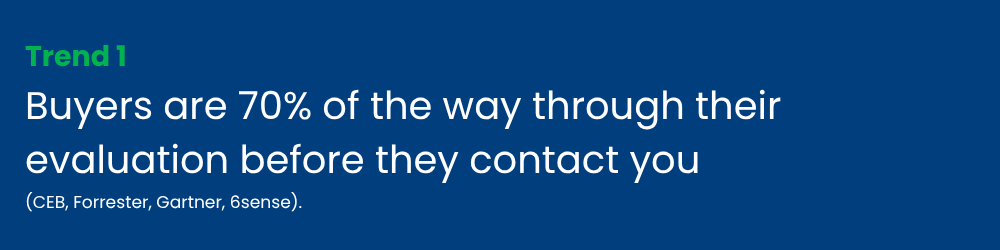
Today’s buyers are far more informed before they ever engage with a salesperson.
They are:
Researching online (Google and in their AI LLM)
Comparing options
Using 3rd party sites (that you don’t control)
Asking peers for recommendations
Consuming LinkedIn content
Reviewing websites and case studies (yours and competitors)
Using AI tools and search engines to narrow down their criteria and shortlist vendors
Forming opinions long before they make contact
Research suggests that B2B buyers spend only a small portion of their buying journey actually talking to suppliers (i.e. you). Instead they prefer self-service research during the early stages of decision-making.
So right now, you may not be that successful in seeking lots of potential buyers who are wanting to engage at a very early stage.
You need to be in the market where and when they are looking in order to build trust and visibility.
That changes the role of both sales and marketing.
But the reality is, most Kiwi businesses are invisible in the research & education phase. We tend to have content that talks about buying our solution, rather than helping people understand what they need and what they should be prioritising.
This example from Lentune shows how ‘useful’ content on the website can help businesses improve their own approach, while subtly positioning a brand as experts in the market.
What to do
Create content that helps to educate prospects about your sector / category, such as explainers, or checklists, for example:
- What should I be looking at when I’m thinking about ABC
- The pros and cons of different providers
- What is XYZ?Make sure there is plenty of evidence in the market that supports YOU being the right choice and builds confidence, including case studies, ROI and proof points etc. If you don’t yet have your own data, think about using supporting industry data and evidence.
AI Search Is Shifting How People Find You
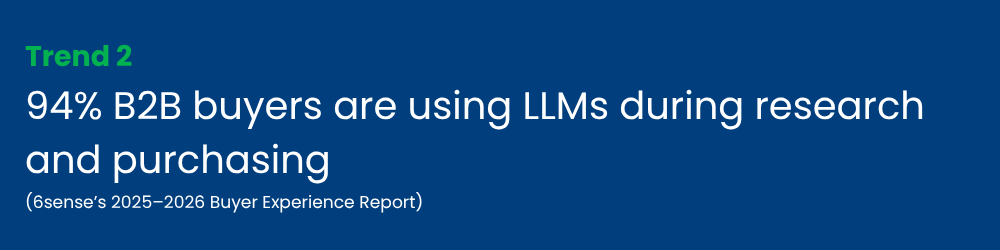
According to 6sense’s 2025–2026 Buyer Experience Report, 94% of B2B buyers now use LLMs like ChatGPT, Claude, and Gemini during their research and purchasing journeys.
Increasingly, buyers ask their AI assistant for help in decision-making: from honing criteria, getting recommendations, comparing vendors, and identifying key risks. AI-assisted search and discovery is growing at a rapid rate, with B2B buyers ahead of the curve and using AI search at 3× the rate of consumers (Column Five Media — AI Search Visibility Stats).
This is happening without even visiting your website.
In most cases, the AI only provides two or three options. Not only that, over 20.5% of keywords on Google searches have AI overviews (you know the little blue boxes with a ‘quick answer’). This means, you no longer need to focus solely on ‘key words’ but think about how people i.e. ‘humans’ ask questions in natural language.
Not only that, LLMs don't care that much about what companies say about themselves. They are sourcing information about you from credible third-party publications, websites and crowd-sourced information, such as Reddit, Wikipedia and industry reviews, which are given far more weight than what we say about ourselves. LLMs are getting better at identifying quality and less easily manipulated by volume, so this will become even more critical going forward.
As a test, search Google for "What is the best accounting software in 2026" and look at the sources - it's rarely the solution providers' websites.
Not only that, ask your colleagues to do the same search - they will get something different. A bit like we’re all presented with very different content on our social media, LLMs are tailoring responses for individuals, so we’re all getting something slightly different in our own search.
These are significant implications for many businesses. You may even have noticed your own website traffic dropping as a result of this changing search behaviour.
If your business is not visible to LLMs, and doesn’t have content that is differentiated and easy to understand for them, you are probably not making the shortlist. If others aren't talking about you in places where there is high domain credibility, that's even more of a problem.
There’s a funny paradox here too: While AI is overtaking how many companies are found (or not) in search, and AI-written content creates noise, the need to sound human is even more important.
What to do
Understand the keywords and phrases your prospects are likely to be looking for
Get a baseline: use an incognito browser and a fresh search window and search for terms you think your market is searching for. What comes up?
Create an action plan to ensure you have:
Clear positioning
Strong messaging
Useful educational content
Answers to real customer questions
Clear articulation of customer outcomes
Think about how you can present these in terms of ‘snackable’ bites of information that can be clipped by AI
Think about how you are working with the right 3rd-party platforms to build external credibility
Keep informed: AI search is changing fast, and is not a one-off set-and-forget
Luckily, the fundamentals of this activity is about clarity of messaging and ensuring your foundational ‘hygiene’ is strong, rather than having to build and create a lot of new tactics, but don’t underestimate there are some ‘new’ actions needed if this is an important source of leads for your business. This was certainly one of the common threads shared by our breakfast event attendees – communicating more clearly was making a difference.
They’ve Already Decided
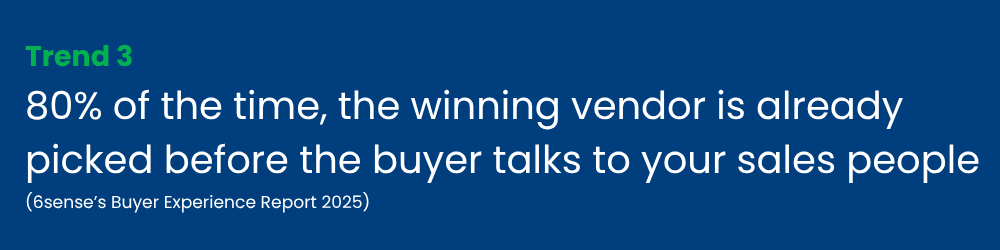
6Sense also found that 95% of the time, the winning vendor was on the day one shortlist, further reiterating the adage “you’ve got to be in it to win it.” This also needs your sales people to understand there is a shift into helping customers validate and confirm their thinking, rather than outright persuasion. If you are not visible early on in the research phase you will find it really hard to engage at this later stage.
If you’ve ever been involved in a tender or RFP this may feel familiar. It’s a whole different approach if you are the one helping the buyer write the requirements than if you are simply responding cold.
Stay in Touch
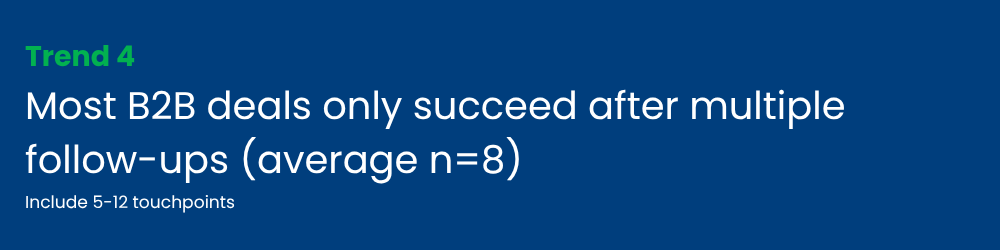
All this talk of self-serving customers knocking on your door (or not) does not mean proactive outreach is dead. Far from it. Targeted and focused proactivity is a vital component of B2B growth. How often does your initial sales outreach land a contract?
Honestly? I’m guessing mostly never. Many business leaders and sales people bemoan how much longer the sales cycle seems to be these days.
Many reports (including the RAIN Group and HubSpot) estimate that the majority of B2B deals actually only get won after multiple follow-ups, between 5-12, with an average of 8. Many businesses I work with can easily cite deals that took well over a year from initial contact to finally winning. Yet, most Kiwi salespeople give up after 1-2 touches. That might be an awkward feeling of hassling someone, a belief that the prospect will get back in touch when they are ready, or simply forgetting in the busyness of moving onto the next task.
Five-plus ‘touches’ does not mean five phone calls or emails ‘checking-in’, but can include a myriad of approaches, from “I saw this and thought of you…”, to an invite to an event. With one client currently we are testing a sequence that includes a personalised video and a direct ‘snail mail.’ Someone else is using ‘lumpy’ mail, i.e. something in the post that is a package. You don’t use these approaches for everyone, but your top tier prospects only.
Here’s an example for someone trying to get an appointment with a decision maker (thanks to Suttle-Straus)
What to do
This is a good example of where sales and marketing should be working really closely together
Ensure your team has a range of options and approaches that can be repurposed, rather than needing to create a fresh approach for each prospect
Test, measure and iterate so you end up with an approach that works for you, including frequency, cadence and approach
Ask: will this cut through the noise?
Create a systematic approach (use a CRM, or even a spreadsheet or calendar reminders)
Automate what you can, even if it is just the internal system, rather than the outbound ‘touch’ - this should always appear to be relevant and human
Engage Across the Buying Committee
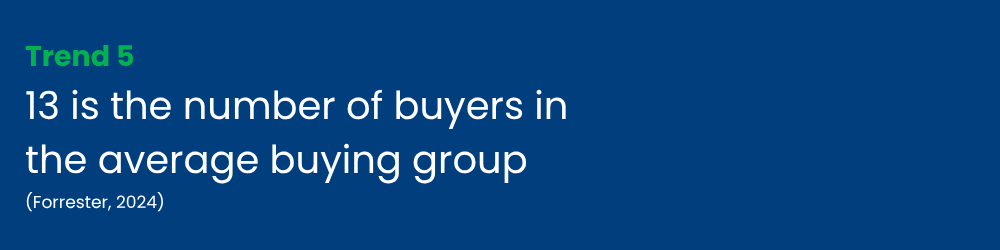
Following on from the previous trend, this one highlights that buying groups are growing and sales cycles are slowing as more people are involved, with different agendas and needs. Typically B2B sales people only engage with two of these stakeholders, which means in the average B2B buying group there’s a range of hidden influencers, decision makers, needs and factors you may be unaware of.
What to do
Map the buying group, understand the different buying types/roles/drivers and create an action plan
If you have a team give them some training on the commercials of your business and involve them in building relationships and keeping in touch with those who are matched to their area, from finance to technology
Buyers Don’t Care What You Do
But they really care about what it delivers to them.
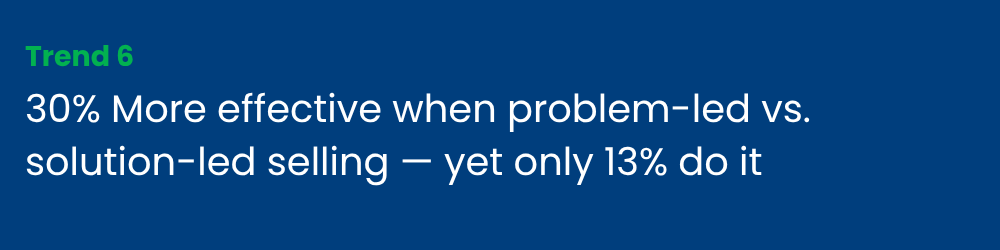
Problem-focused sellers are 30% more effective than solution-focused ones
But only 13% of sellers lead with the problem
38% increased win rates when buyers & sellers align on problem-definition
I think this is a particular challenge in the technical space. We love our detailed descriptions of the tech, the process or model we use and what the final output will look like.
But increasingly, buyers are becoming more outcome-focused. They (broadly) don’t care about:
Technical capability lists
Long feature descriptions
How many meetings, documents and checklists are involved
They want to know:
Do you understand my problem?
Have you solved it before, with people that look like me?
What impact you can create that supports what I’m trying to achieve
How you present yourself will depend on your audience and what is important to them. For example, providing outcomes for ratepayers when dealing with NZ local government may be very different from the outcomes you’d focus on for a US-based aeronautical company.
Xero is a good example. Their lead messaging is about control, time saving and confidence. Not a mention of platform or process.
What to do
Audit your messaging. Are you communicating the how and what you do, rather than the benefits, outcomes and value you are providing?
Doing Nothing Is Not an Option
The way your prospects are looking to solve their problems has changed, from the way they find information, to how and when they want to engage with you. This does not mean you have to do a lot MORE, but you do need to get smart about WHAT you do and how you do it.
Many of these challenges are relatively easy to solve with some renewed focus.
Get clear on your positioning and messaging: who you help, with what, and why it matters to them
Create content that helps buyers in the research phase, not just content that promotes your solution
Build visibility beyond your own website, including case studies, third-party mentions, LinkedIn presence
Bring together your sales and marketing team, with the same goals and shared visibility of priorities, so neither is working in isolation
Build sales and marketing systems and processes for consistent engagement with prospects and customers
And please - don’t think that because you have always done sales and marketing a certain way, that is going to stand you in good stead going forward; these changes are really happening.
The question to ask your team:
“How do we remain visible, credible and relevant in a buying environment that has fundamentally changed?”
Get In Touch

We partner with CEOs and leaders of B2B tech and services companies who are ready to grow.
We have a particular sweet-spot for helping teams where there is a low-volume, high value offering that involves a personalised sales approach. ♥️
We help you get a plan that is aligned with your business objectives, and build a ‘growth engine’ that turns your marketing and sales activity into something that scales with you as you grow.
If you are looking to grow your business and are interested in building a sustainable approach to growth, then I’d love to chat.
Give me a shout,
Helen
021 900335
FAQs
-
The key trends in B2B selling and buying right now include buyers researching independently long before contacting vendors, widespread use of AI tools like ChatGPT during that research, winning vendors often being chosen before sales conversations start, larger buying groups averaging around 13 people, deals requiring more follow-ups to close, and buyers responding better to outcome-focused selling than feature-focused selling.
-
The B2B buying and selling environment in New Zealand is changing for several reasons. The main ones include buyers doing more research before contacting vendors, rely heavily on AI search and third-party sources, and often decide on a preferred vendor before sales conversations begin. Most NZ businesses haven't adjusted their sales and marketing approach accordingly, leaving a growing gap between how buyers buy and how organisations are set up to sell.
-
New Zealand B2B businesses can respond to changing buyer behaviour and expectations by sharpening their positioning and messaging, creating educational content for the research phase, building credibility through third-party sources, aligning sales and marketing, and building a systematic, multi-touch follow-up approach for top prospects rather than relying on one-off outreach.
-
B2B buyers usually reach out to vendors once they're about 70% of the way through their evaluation process, according to research from CEB, Forrester, Gartner and 6sense. By that point they've typically already researched online, compared options, consulted peers, and formed strong opinions about who's on their shortlist.
-
94% of B2B buyers now use LLMs during research and purchasing. This matters because what these tools tell buyers about a company depends far more on what third-party sources, like industry reviews Reddit and Wikipedia say about it than on what the company says about itself on its own website. If a business isn't visible and credible in those third-party spaces, it's less likely to make the shortlist these tools generate.
-
When evaluating vendors, B2B buyers care most about outcomes rather than technical capability. They want to know whether a vendor understands their problem, has solved it before for similar businesses, and can deliver the impact they're trying to achieve, rather than hearing about features, processes or technical detail.
-
Winning a B2B deal typically takes between 5 and 12 follow-ups, averaging around 8. Most NZ salespeople give up after 1-2.
-
A B2B buying decision typically involves around 13 people, though most B2B sales reps only engage with one or two of them.